Across seven states, new billboards use regional football rivalries to highlight the costs of tariffs and the trade war with Canada.
EMBARGOED FOR WEDNESDAY, SEPTEMBER 16, 2026 AT 5 A.M. ET.
WASHINGTON – Wednesday, September 16, 2026 – Today, Small Businesses Against Tariffs launched a new billboard and digital ad campaign with a message for football fans: Tariffs are worse than their rival team. As college and professional football return, we are using familiar rivalries to highlight the economic costs of tariffs on American small businesses, workers, and consumers.
We are placing billboards along highways and in major metro areas across seven states: Michigan, Indiana, Ohio, Wisconsin, Pennsylvania, Iowa, and Illinois. The ads ask: “What’s worse than your football rival?” and answer: “Tariffs.” The billboards can be viewed here and their locations can be viewed here. (You are free to use these images with credit to Small Businesses Against Tariffs.)
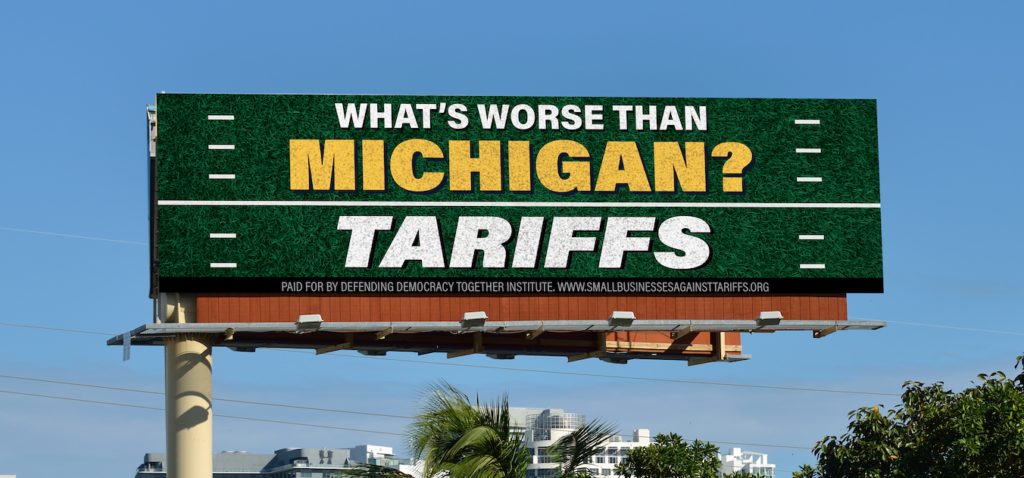
Other versions of the billboard ask what’s worse than losing on Saturday or Sunday. The billboards bring lighthearted game-day ribbing and old-fashioned regional rivalries to a serious kitchen-table issue: Families and businesses in states with deep trade ties to Canada are struggling badly right now, and tariffs are directly affecting their pocket books.
In addition, the campaign includes a digital video ad introducing “Tariff Plus,” billed as “the subscription you didn’t sign up for and can’t cancel.” The spoof retro infomercial highlights that tariff costs keep showing up in Americans’ everyday purchases. Watch the video here:
Our campaign launches as the tariff war with Canada is escalating. Following US tariffs of 50 percent on specified Canadian goods in August, Canada imposed new retaliatory tariffs of 15, 25, and 50 percent on selected US goods on September 8. Additional import bans on select Canadian goods, including some dairy products and alcoholic beverages, are scheduled to take effect on September 29.
The campaign is running in the seven states that buy the largest quantities of Canadian materials and parts. They are also home to businesses that sell American-made goods across the border. US tariffs raise costs for importers and manufacturers; Canada’s retaliation makes US exports more expensive for Canadian buyers. For a small business, that can mean higher costs on supplies, fewer orders, and less room to keep prices down.
“When goods come into this country, it’s the importer who pays the tariff. Canada doesn’t write that check,” said Kimberly Daniels, CEO of Mercantile Logistics & International Trade, Inc. and a participant in the Small Businesses Against Tariffs campaign. “Those costs put pressure on small businesses to raise prices. And it’s hard to plan your next shipment when the tariff rules keep changing.”
“Small businesses like ours are the backbone of the American economy, and we’re being squeezed right now by these tariffs,” said Eva St. Clair and Rebecca Melsky, co-founders of the children’s fashion brand Princess Awesome and participants in Small Businesses Against Tariffs. “It would be nice if the government lent a helping hand—or at least got out of the way—rather than actively sabotaging our bottom line.”
Small Businesses Against Tariffs is a public education initiative helping Americans understand how tariffs really work and who pays for them. We have always opposed tariffs and our website includes helpful tools, including a timeline of tariffs over the past 100 years in America, and their impacts on the broader economy.
To be connected with the business owners associated with this campaign, or for other questions, please reach out to franquiz@longwellpartners.com.
# # #